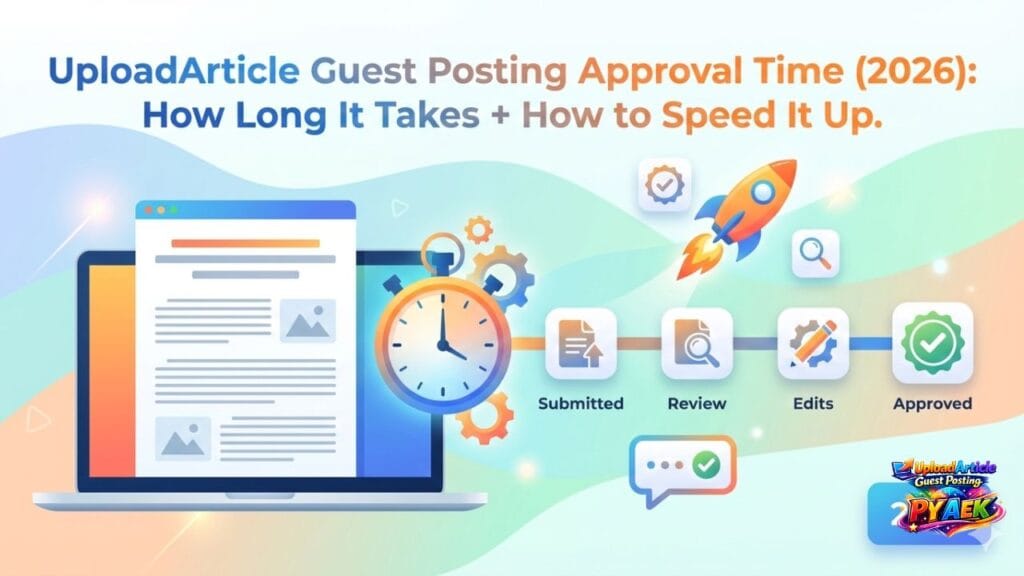
If you’ve submitted a draft and you’re waiting for a response, the first question is always the same: how long does approval take? In this guide, we’ll break down typical UploadArticle guest posting approval time in 2026, what causes delays, and the fastest ways to reduce revision cycles. If you’re new, start from UploadArticle Guest Posting.
For a full checklist you can run before submitting, read: UploadArticle guest posting guidelines checklist.
Typical approval and publishing timelines
Timelines can vary based on workload and draft quality, but most submissions fall into predictable ranges. Think of the process as two steps: (1) editorial review/approval, and (2) publishing/scheduling.
Here’s what most people can expect:
- Editorial response (approval or edits): usually 24–72 hours
- If edits are needed: depends on how quickly revisions are sent back (often 1–3 days)
- Publishing after approval: commonly 3–7 days depending on the schedule
If you want the official requirements, review Guest Posting Guidelines before submitting.
What affects UploadArticle guest posting approval time?
Approval time is mostly driven by how much work an editor needs to do to make the post publish-ready. A clean draft can be approved quickly. A draft with weak structure, heavy promotion, or messy links usually takes longer.
The main factors are:
- Topic fit: does the post match the category and audience?
- Structure: clear H2/H3 headings and short paragraphs vs. long blocks of text
- Originality and usefulness: does it add unique value or feel generic?
- Link quality: relevant, minimal links vs. spammy or irrelevant linking
- Formatting: clean bullets, consistent headings, and a clear conclusion
Top reasons submissions get delayed
Delays usually happen when a draft needs clarification or cleanup before it can be approved. These are the most common reasons editors pause a submission:
1) The article is too promotional
If the post reads like an ad, it often needs a rewrite. The fastest fix is to shift the goal: teach first, and keep any brand mention minimal and neutral. Add examples, steps, and alternatives so the post stands on its own.
2) Weak structure (no clear headings)
Editors prefer drafts that are easy to scan. If everything is in one long paragraph, it takes longer to review. Use H2 sections for main points and H3 for sub-sections like examples, tools, or warnings.
3) Generic content (low value)
Posts that restate obvious facts without depth often get pushed back for improvements. Add specifics: real steps, mini-checklists, mistakes to avoid, and a clear ‘do this next’ conclusion.
4) Links look irrelevant or excessive
Too many links—or links that don’t match the topic—can slow down approval. Keep links minimal, contextual, and genuinely helpful.
5) Missing basics (images, conclusion, or clarity)
Images are optional, but clarity isn’t. If the post ends abruptly or lacks takeaways, editors may request a conclusion. A short summary section can speed up approval because it shows clear intent.
How to speed up approval (practical checklist)
If you want a faster turnaround, treat your submission like a publish-ready article—not a draft. Here are practical ways to reduce review time:
Make your structure editor-friendly
Use an outline that matches what readers expect: an intro, clear H2 sections, and a conclusion. Add bullets where needed so the editor can scan quickly.
Write for humans, not just search engines
Use the keyword naturally, but don’t repeat it in every paragraph. A good rule: if the sentence sounds unnatural, rewrite it. Clarity beats repetition.
Keep links minimal and relevant
Choose 1–3 highly relevant links and avoid aggressive anchor text. Use natural wording that fits the sentence.
Add a short “quick summary” section
A short summary at the end shows completeness and helps editors confirm the post delivers on its promise. It also improves reader experience.
Submit clean files and clear notes
Use Google Docs (preferred) and include: topic, target audience (USA/global), category, and any relevant links. When everything is clear, the review is faster.
Rejected vs. revision requested: what it means
Many people interpret ‘needs edits’ as a rejection. In reality, it often means the editor sees potential but needs improvements before publishing. A revision request usually focuses on one of these: tone (too promotional), structure, originality, or links.
If you respond quickly with clean revisions, the overall timeline stays short. If revisions take a week, the process naturally stretches.
A simple workflow to get approved faster
Use this workflow to reduce delays:
- Run a quick pre-submit check using the guidelines checklist.
- Make sure headings are clean and the conclusion is included.
- Limit links to relevant, contextual references.
- Submit your draft with clear notes (topic, category, audience).
- If edits are requested, reply with changes in one clean revision round.
Checklist: UploadArticle guest posting guidelines checklist • Rules: Guest Posting Guidelines
Ready to submit?
If your draft is ready, use Submit Article for review. If you want help polishing your draft and reducing revision cycles, see Pricing.
Quick summary
Typical editorial response time is 24–72 hours, and publishing often happens within a week after approval. To speed things up, focus on topic fit, clean structure, minimal relevant links, and a clear conclusion.