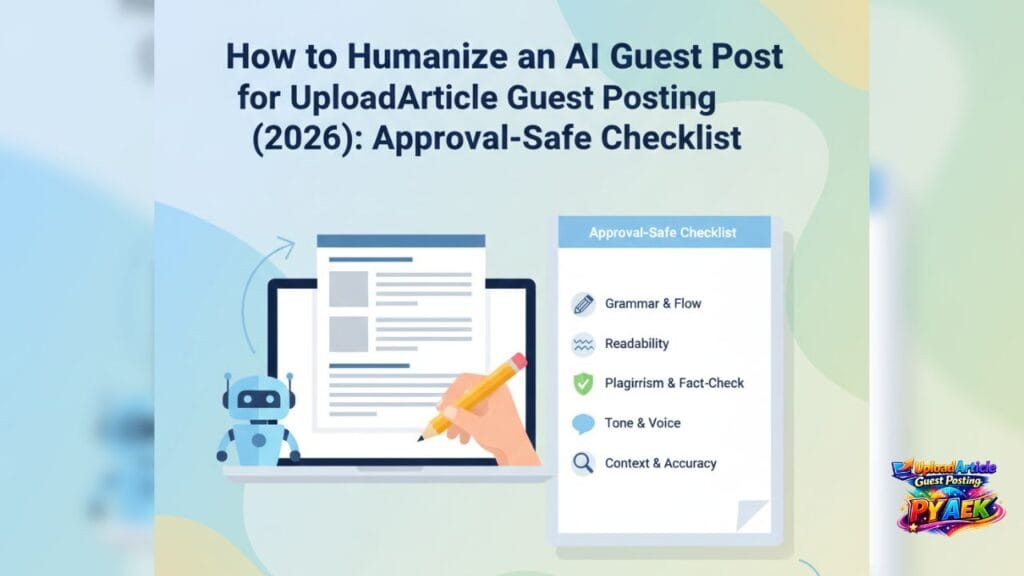
AI tools can speed up drafting, but low-effort AI writing is one of the fastest ways to trigger revisions—or a rejection. The goal isn’t to “hide” AI. The goal is to turn a rough draft into a helpful, original article that reads naturally. This 2026 checklist shows exactly how to humanize an AI guest post so it’s approval-safe. If you’re new to the process, start from UploadArticle Guest Posting.
Before you edit, review the guidelines checklist and keep link rules in mind (see link policy).
Why AI drafts get delayed or rejected
Most AI drafts fail for the same reasons: they sound generic, repeat points, and lack real examples. Editors can spot this quickly because the writing feels “smooth” but empty. To get approved, your draft needs a clear point of view, specific steps, and original value.
Common AI-draft problems include:
- Generic statements that could apply to any industry
- Repetition (same idea said three ways)
- Overly formal or robotic tone
- No real examples, templates, or mini-case scenarios
- Weak structure (lots of paragraphs, little hierarchy)
Step 1: Start with a human outline (not a full AI article)
If you can change one thing, change this: don’t generate a full article first. Start with a human outline and then use AI to help fill sections. A human outline makes the final post feel intentional.
Use this outline template:
- Intro: who this is for + what result they’ll get
- H2: quick context (what the problem is and why it matters)
- H2: step-by-step method (3–7 steps)
- H2: mistakes to avoid
- H2: tools/resources (optional)
- Conclusion: summary + next step
Step 2: Add originality (the easiest ways)
Originality doesn’t mean inventing new science. It means adding something that isn’t copied from the internet: your own examples, your own structure, and your own reasoning.
Fast originality upgrades:
- Add a mini case scenario (“If you’re a USA local service business…”)
- Create a checklist readers can follow
- Add a short ‘common mistakes’ section based on real patterns
- Include a simple template readers can copy (email, outline, steps)
- Explain trade-offs (when to do X vs Y) instead of one-size-fits-all advice
Step 3: Fix the tone (make it sound human)
Human writing has rhythm: short sentences, occasional emphasis, and natural phrasing. AI writing often looks polished but flat. Your job is to make it feel like a person wrote it for real readers.
Practical tone edits that work:
- Replace overly formal phrases with simple words
- Remove filler intros (e.g., ‘In today’s fast-paced world…’)
- Add short punchy sentences for emphasis
- Use contractions where natural (you’ll, don’t, it’s)
- Cut repeated points and keep the strongest version
Step 4: Upgrade structure for approval
Structure is one of the biggest approval factors. A well-structured article is easier to review and publish.
Make sure your draft includes:
- H2 sections that match the main steps
- H3 sub-sections for examples, tools, and warnings
- Bullets for lists (instead of long paragraphs)
- A conclusion with key takeaways
If you want a full structure checklist, see the guidelines checklist.
Step 5: Make links look natural (avoid spam signals)
AI drafts often insert links in unnatural places or use aggressive anchors. Keep links minimal, relevant, and readable.
Safe link rules:
- Use 1–3 outbound links max (most topics)
- Use natural anchor text (brand name or neutral phrase)
- Place links only where they support the reader
- Remove any link that feels unrelated or overly promotional
Full link guide: UploadArticle guest posting link policy.
Step 6: Do a final ‘editor test’ before submitting
Before you submit, run this quick editor test. It takes 5 minutes and catches most problems.
Editor test checklist:
- Does the intro promise a clear outcome?
- Can I skim headings and understand the full article?
- Are there real examples or steps (not just generic advice)?
- Do links feel helpful and minimal?
- Is there a conclusion that summarizes the value?
If you got rejected: how to fix an AI draft fast
If a draft was rejected, don’t throw it away. Fix structure, remove promotion, cut repetition, add examples, and re-submit. Most AI-related rejections are solved by adding originality and tightening the outline.
Use this guide for fixes: rejection reasons + fixes.
Ready to submit your draft?
When your draft is polished, use Submit Article for review. If you want help rewriting and improving approval chances, check Pricing.
Quick summary
AI drafting is fine, but approval depends on human editing: add originality, fix structure, remove repetition, keep links minimal, and write for readers. A humanized draft gets approved faster and performs better long-term.