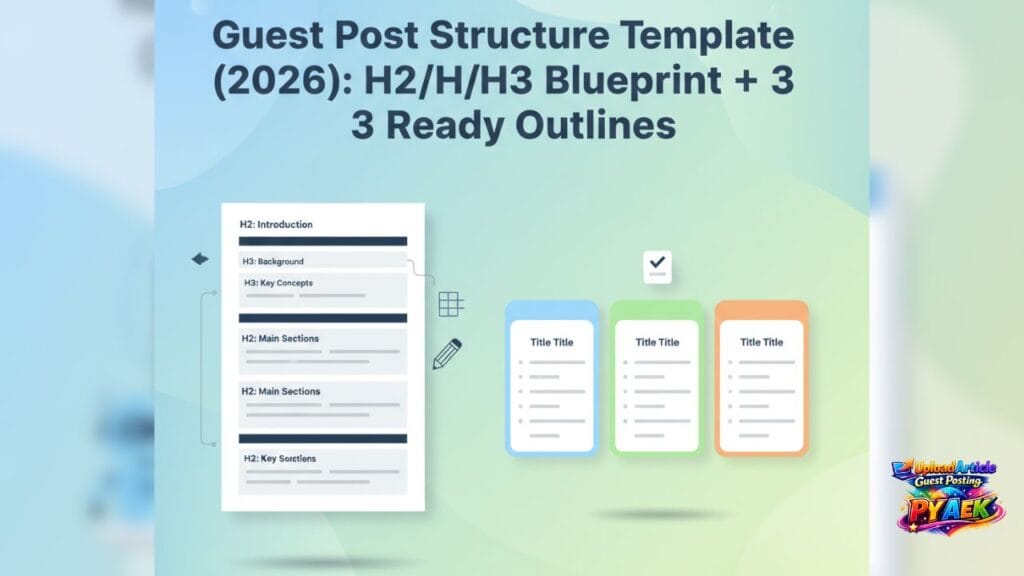
Structure is one of the easiest ways to get approved faster. Editors don’t want to “fix” the article—they want to review a publish-ready draft. If your guest post is well-structured, it’s easier to scan, easier to edit, and more useful for readers. In this guide, you’ll get a simple H2/H3 blueprint plus three ready-to-use outlines. If you’re new, start from UploadArticle Guest Posting.
Before you write, it helps to review the guidelines checklist and keep link safety in mind (see link policy).
Why structure matters (approval + SEO)
A strong structure does two things at once: it improves approval odds and it improves SEO. For approval, structure reduces revision requests because the editor can clearly see the logic of the post. For SEO, headings help search engines understand the topic coverage and help readers scan quickly.
A publish-ready structure usually includes:
- A short intro that sets expectations
- Clear H2 sections that represent the main steps/ideas
- H3 sub-sections for examples, tools, and mistakes
- Bullets and short paragraphs to improve readability
- A conclusion with takeaways and next step
The universal H2/H3 blueprint (copy this)
Use this blueprint for most topics:
H1: Clear title that matches the reader’s intent
Your H1 should tell the reader what outcome they will get. Avoid vague titles. Make the promise clear.
Intro (2–4 lines): who it’s for + what they’ll learn
In the first paragraph, say who the guide is for, what problem it solves, and what the reader will be able to do by the end.
H2: Quick context (optional but useful)
Explain the problem in 1–2 short paragraphs. Keep it tight. This section sets up the steps that follow.
H2: Step-by-step method (the core)
This is the main section. Use 3–7 steps. If needed, use H3 for examples or tool suggestions.
H2: Common mistakes (fast trust builder)
Add 3–6 mistakes with quick fixes. This makes the post feel practical and experienced, not generic.
H2: Tools/resources (optional)
List 3–5 tools max. Keep it neutral and helpful. Don’t turn this into a promotion section.
H2: FAQ (optional but great for intent coverage)
Add 4–6 FAQs that match what a reader would ask. Keep answers short and direct.
H2: Conclusion + next step
Summarize key points and give a single next action (e.g., submit the draft, apply the checklist).
3 ready outlines (copy/paste and write)
Below are three outlines you can copy and fill. Each one follows the approval-safe blueprint above.
Outline #1: Checklist-style how-to post
- H1: [Topic] Checklist (2026)
- Intro: outcome + audience
- H2: What you need before you start
- H2: Step-by-step checklist (7–12 bullets)
- H2: Common mistakes + fixes
- H2: Quick FAQ
- H2: Conclusion + next step
Outline #2: Process guide (step-by-step)
- H1: How to [Achieve Result] in [Timeframe]
- Intro: who it’s for + what you’ll learn
- H2: Step 1 — [Action]
- H2: Step 2 — [Action]
- H2: Step 3 — [Action]
- H2: Mistakes to avoid
- H2: Tools/resources (optional)
- H2: Conclusion + next step
Outline #3: Comparison post
- H1: [Option A] vs [Option B] (2026) — Which is Better?
- Intro: what you’ll compare + who it’s for
- H2: Quick summary (who should choose what)
- H2: Key differences (table or bullets)
- H2: Pros/cons of Option A
- H2: Pros/cons of Option B
- H2: Common mistakes
- H2: Conclusion + recommendation
Pre-submit structure checklist (5 minutes)
Before submitting, confirm:
- The title promises a clear outcome (not vague)
- Headings tell the full story when skimmed
- Paragraphs are short and easy to scan
- Bullets are used for lists (not walls of text)
- There is a conclusion with takeaways
- Links are minimal and natural (see link policy)
Full checklist: guidelines checklist • Link safety: link policy
Ready to submit?
When your post is structured and polished, submit it here: Submit Article. If you want help rewriting and improving structure, check Pricing.
Quick summary
Use a simple blueprint: intro → steps → mistakes → conclusion. Add H2/H3 hierarchy, short paragraphs, and minimal links. A clean structure improves approval odds and helps SEO at the same time.