If you’re buying or submitting guest posts, you’ll hear one question constantly: “Is it dofollow?” But in 2026, link type is only one part of the story. What matters more is relevance, editorial value, and whether your links look natural. This guide explains the difference between dofollow, nofollow, and sponsored links, when each tag makes sense, and how to keep guest posting link placement safe. If you publish with us, start here: UploadArticle Guest Posting.
Our practical link rules are explained in UploadArticle guest posting link policy.
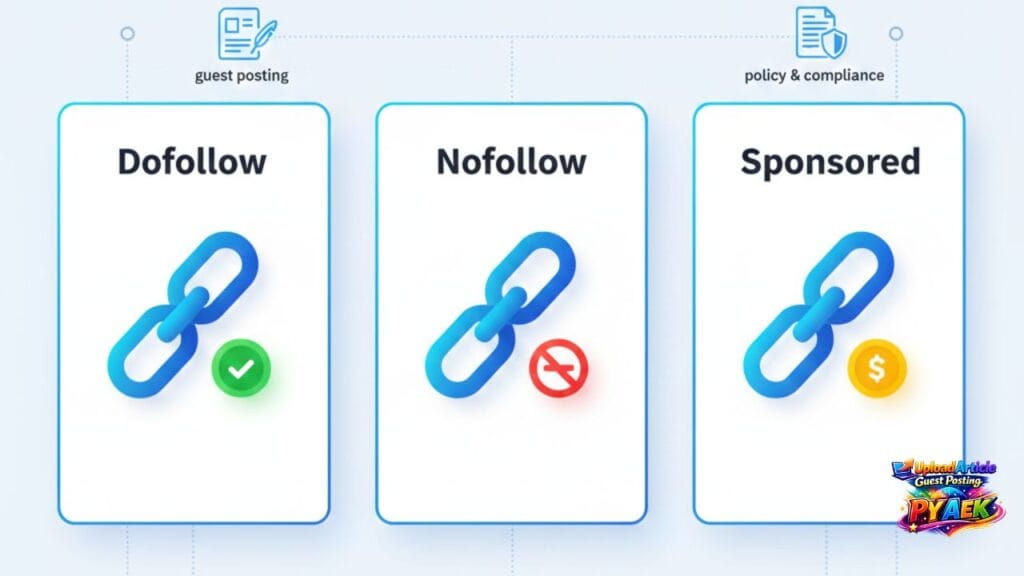
Quick definitions (simple explanation)
Here’s the simplest way to understand these tags:
Dofollow (default links)
Most links on the web are dofollow by default. This means search engines can follow the link and may pass ranking signals.
Nofollow
A nofollow attribute tells search engines the site isn’t explicitly endorsing that link. Search engines may still crawl it, but it signals reduced editorial endorsement.
Sponsored
Sponsored is used for paid, affiliate, or compensated links. It’s a transparency signal that the link exists because of a commercial relationship.
UGC (bonus)
UGC (user-generated content) is often used for links inside comments, forums, or user profiles.
What matters most in 2026 (hint: not just the tag)
Many people obsess over “dofollow vs nofollow,” but search engines evaluate the bigger picture: the site relevance, content quality, and link patterns. The safest guest posts are editorial and useful first.
In practice, the strongest guest posts are:
- Useful and editorial (valuable even without any links)
- Relevant to the site’s category and audience
- Link-light (minimal links, placed naturally)
- Consistent with the site’s normal linking behavior
If your draft keeps getting delayed, use the editorial checklist.
When to use dofollow vs nofollow vs sponsored (practical rules)
Use dofollow when:
- The link is truly editorial and relevant
- It helps readers (reference, tool, definition, source)
- It’s not clearly paid/compensated
Use nofollow when:
- You can’t fully vouch for the destination
- It’s a mention that doesn’t need endorsement
- You want to reduce risk for borderline links
Use sponsored when:
- The link is paid, affiliate, or compensated
- A commercial relationship exists (direct or indirect)
- You want clear transparency for compliance
Guest posting link policy: what keeps you safe
The safest guest posting policy is simple: keep links minimal, relevant, and natural. Avoid exact-match anchors at scale.
Safe link placement checklist:
- 1–3 outbound links max (most posts)
- Natural anchors (brand, URL, or descriptive phrase)
- No link stuffing in intro/conclusion
- Links should match the paragraph context
- Avoid repeating the same anchor across multiple posts
Full guide: UploadArticle link policy.
Common mistakes that trigger edits or rejection
These are the patterns that usually cause problems:
- Too many outbound links
- Unrelated links (doesn’t match the topic)
- Aggressive anchors (exact-match repeated)
- Overly promotional paragraphs around links
- Thin content built only to support a link
Fix guide: rejection reasons + fixes.
FAQ: link tags for guest posting
Do I need dofollow links to get results?
Not always. A great guest post can drive referrals, brand searches, and trust even without dofollow. Quality and relevance matter more than the tag.
Are sponsored links bad?
Not inherently. Sponsored is a disclosure tag. The risk comes from unnatural patterns and low-quality placements—not from transparency.
How many links should I include in a guest post?
Keep it minimal. Most strong editorial posts need 1–3 outbound links max.
Will my post be rejected if I ask for dofollow?
Asking isn’t the issue—over-optimizing and forcing links is. The safest path is natural linking that fits the content.
Want to submit a guest post?
Submit your draft here: Submit Article. If you want help with writing/editing and link compliance, explore Services and packages on Pricing.
Quick summary
Dofollow is the default. Nofollow reduces endorsement. Sponsored is for paid relationships. In 2026, the safest approach is editorial content + minimal natural links. Focus on relevance and quality first.